Types of Outdoor Lighting: What Each One Does and Where It Belongs
Walk through any well-designed Northern Colorado property after sunset, and you'll notice something. The outdoor lighting doesn't feel like lighting. It feels like the house just looks that way. That's because the people who planned it used the right type of fixture for each job, then got out of the way.
There's no single "outdoor light." There's a toolkit, and each tool has a purpose. Here's how we break it down when we're planning a job in Fort Collins, Loveland, or anywhere in our service area.
Path and walkway lights
These are the shorter fixtures you see spaced along sidewalks, garden edges, and driveway borders. Most sit between 18 and 24 inches tall, throw a soft pool of light downward, and run on low voltage. Good path lights keep feet where they should be without blinding anyone.
Common mistake: spacing them like airport runway lights, four feet apart. Real path lighting is closer to 8 to 10 feet, with enough throw between fixtures to read as continuous rather than a string of dots.
Step and deck lights
Recessed step lights are small, usually LED, and mounted into the riser of a staircase or the side of a deck post. They're the quiet workhorse of outdoor lighting. No glare, no wasted light, just enough to see the edge of the next step.
On a Colorado deck that gets real winter use, step lights are worth the install every time. Ice plus darkness plus a misjudged stair is a recipe for a bad night.
Wall-mounted sconces and lanterns
These sit on either side of garage doors, entry doors, and sometimes along long exterior walls. They're both architectural and functional. A pair of properly sized lanterns on an entry changes the whole face of a home.
A common problem is scale. Most builder-grade lanterns are too small for the door they flank. We tell clients to measure the door height and aim for fixtures roughly a quarter of that height, sometimes more on a two-story entry. If you're not sure how to think through it, our guide to choosing outdoor lighting walks through fixture selection in detail.
Floodlights and security lights
Floodlights throw a wide, bright beam and are usually mounted high. Security-specific versions add motion sensors and sometimes cameras. They're not subtle, and they're not supposed to be.
The trick with floodlights is aim and glare. A floodlight pointed slightly down and away from the property line lights your yard. The same fixture pointed level lights your neighbor's bedroom. We see this one on almost every walkthrough. Point the light where you want it, not where the manufacturer mounted the bracket.
Security lighting should also be paired with a motion sensor so it's only running when something triggers it. Permanent floodlighting is rarely the answer, and it isn't kind to anyone trying to sleep.
Spotlights and uplights
Spotlights cast a narrow, focused beam. Uplights are spotlights aimed at the ground pointing up, typically used on trees, columns, stone features, and architectural details. This is where outdoor lighting starts to feel intentional.
A well-placed uplight on a mature aspen in the front yard does more for curb appeal than almost any other single fixture. Two of them, cross-aimed, do even more. Just don't overdo it. Three uplights per tree is usually plenty.
Downlights and moonlighting
Downlights mount high in trees or under eaves and cast light downward, often through branches. The effect is called "moonlighting," and when it's done right it looks like the moon is sitting just above your yard.
This is one of our favorite techniques on larger properties. It lights a big area without any fixture being visible at eye level. Expensive to install. Worth it.
Hardscape lights
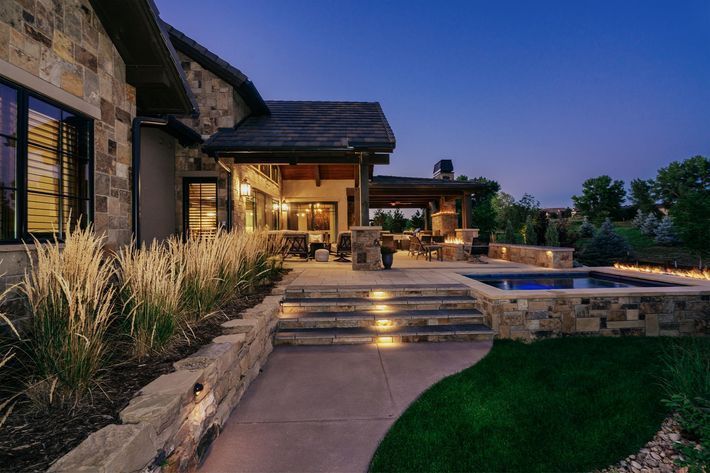
These are small, linear LED fixtures built into or mounted on retaining walls, stair treads, pergolas, and capstones. They're nearly invisible during the day and add a warm line of light at night.
Hardscape lighting does a lot of heavy lifting for backyard entertaining. If you spent money on a stone patio or a built-in fire pit, it should have hardscape lighting integrated into it.
String lights and market lights
The café-style bulbs strung across a patio or pergola. They're not serious architectural lighting, but they make a space feel warm and used. Fine for a patio. Not a substitute for real path or task lighting.
In Colorado, look for bulbs rated for outdoor use and shatter-resistant housings. Hail doesn't negotiate with glass string lights.
In-ground and well lights
These sit flush with the ground, aimed up. They're used for uplighting walls, facades, and large trees when you don't want a visible fixture.
The installation is more involved because they have to be sealed against water, and in our climate, they need to handle snowmelt and freeze cycles too.
A few rules that cut across all of them
Pick warm color temperatures, 2700K to 3000K, for residential exteriors. We explain the reasoning in what colors are best for outdoor lighting and why.
Size the brightness to the job. Not every fixture needs to be bright. Our lumens guide breaks down the numbers by fixture type.
Before you buy line-voltage fixtures or plan a larger system, check the permit rules. In Colorado, exterior electrical work often triggers one. Our rundown on permit requirements for exterior lighting in Colorado covers what to expect.
When to call a crew
Some of this you can do yourself. Swapping a sconce, adding a string of solar path lights. Fine. But when you're running new circuits, trenching cable, or trying to design a layered composition across a whole property, the job gets harder fast.
We've been installing lighting on Northern Colorado homes since 1998. You can see the full picture of what we handle on our indoor and outdoor lighting installation page, and lighting is one piece of everything we cover across home renovations and home maintenance.
Pick the right type for the job, set it up to survive the climate, and you'll have a property that works after dark for a long time.